 marta.albujar
29 de septiembre de 2022
marta.albujar
29 de septiembre de 2022
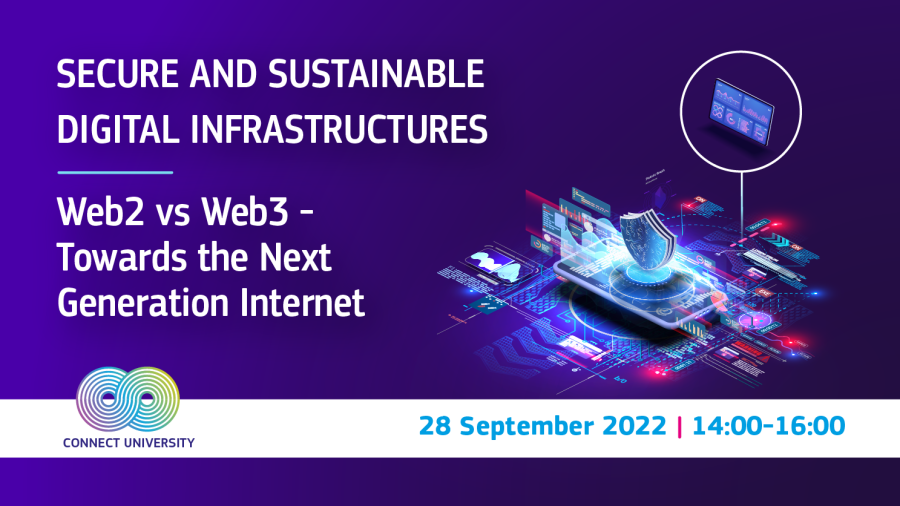
The Internet is one of the biggest projects of humankind. And the EU has an evolving, articulated set of principles and legal instruments and initiatives supporting and impacting the EU vision for the future Internet. And if according to the Next Generation Internet principles, the Internet should be free, open, global, and based on interoperable solutions, how will these principles be implemented in Web3 to ensure secured digital identity and trusted data operations?
That was the main focus of the session From Web2 to Web3: Towards the Next Generation Internet, which was held at the CONNECT University Autumn School 2022 on Secure & Sustainable Digital Infrastructures. The Deputy Head of Unit of the Next Generation Internet, Gemma Carolillo, was one of the panelists. She opened the session introducing the NGI vision and how it puts humans in the centre. The technical development of the Internet in Europe is, according to the representative of the DG CONNECT, fueled by the NGI Research and Innovation funding schemes.
Carolillo highlighted how “cascade funding helps us get closer to innovators''. On the one hand, the NGI has invested more than €80m under Horizon 2020 and, by the end of 2024, €106 more millions will have been distributed. As of now, the NGI has funded more than 600 projects, generating the same amount of human-centric hardware and software solutions, 80% of which are open source. Carolillo mentioned specifically some of the NGI decentralised solutions, most of them focused on SSI, like BC Diploma, GATACA, Bloqzone, Decentralized Science, or BRIAR.
Shermin Voshmgir, Founder of Blockchain Hub and Token Kitchen, centered her intervention on Web3 and the TOKEN Economy. She explained how the web evolved from the Web of information, to the Web of platforms, to the Web of tokens. The latter is changing the way that the Internet functions on its back end, from clients communicating to servers, to an infrastructure that is built on a peer-to-peer approach; while on the front end the access is given via wallet applications. All with a goal to preserve data and identity.
Fernando Almeida, Professor at Instituto Superior Politécnico Gaya, dove into more details of the Web3 concept and potentialities. According to Almeida, the Web3 is bringing together Computer Science, Maths and Statistics and Business and Domain expertise to mainly:
Paola Heudebert, Head of Legal & Public Affairs archipels.io and Chair of INATBA’s Privacy Working Group, put more light on a concern when debating about the Next Generation Internet and the application of its principles to Web3: cybersecurity. Heudebert detailed the opportunities and challenges in Web3 data protection. How should regulation deal with cybersecurity and privacy issues in Web3?
After the individual interventions, a very rich conversation with the audience about open source, trustworthiness and self-governed Web3 took place.
The video of the whole session can be retrieved here: https://youtu.be/M2brPQz-cwk
https://youtu.be/M2brPQz-cwk