 marta.albujar
26 de mayo de 2021
marta.albujar
26 de mayo de 2021
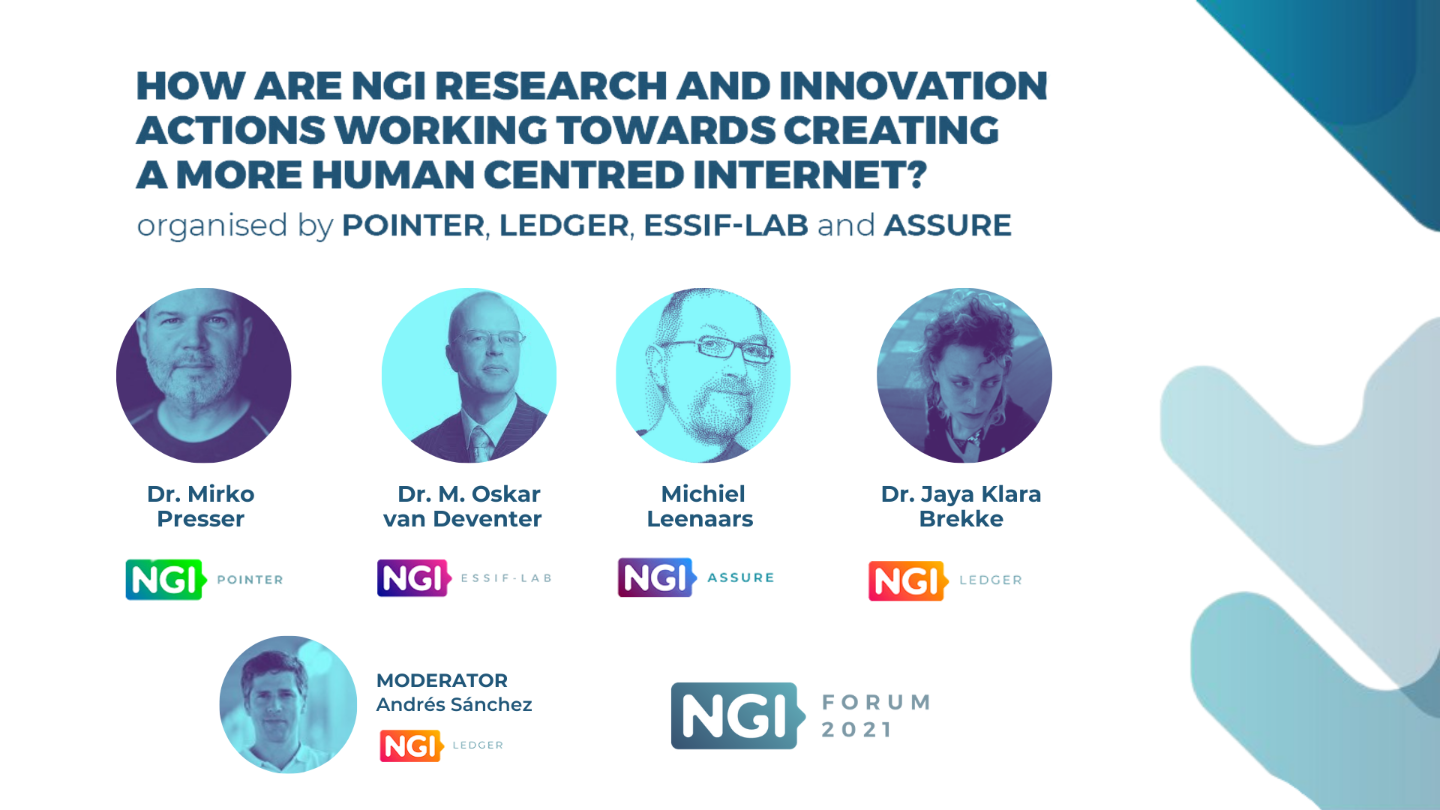
What happens when you put 5 innovation and human-centric Internet passionate people into a (virtual) room? A lot of food for thought is assured!
That is what happened last week at the #NGIForum21, in the workshop dedicated to present how the NGI Research and Innovation Actions (RIAs) are working towards a human-centric Internet. The session gathered four of the experts involved in the Next Generation Internet (NGI) RIAs, plus one of the LEDGER NGI innovators.
In a panel facilitated by Andrés Sánchez @andres.ss, project coordinator from @Fundingbox in LEDGER, the five Next Generation Internet (NGI) enthusiasts discussed the concept of human-centricity and how the different branches of the NGI initiative are shaping the application of a European approach to the Internet, versus the market-oriented or the surveillance-based models of the USA and China.
Andrés Sánchez introduced the panel with the interesting view of Lynge Asbjørn Møller from NGI Forward about the eight goals for a human-centric internet. First, there are some goals centered in the individual sphere, such as having a safer online environment and control over our own data. But there is also a social approach, according to which we should aim for trustworthy information flows to prevent misinformation and public opinion’s manipulation and control, as well as for an inclusive Internet that welcomes everyone.
NGI as a mechanism focusing on open source, focusing on decentralisation makes a lot of sense. It is a very powerful generic principle to avoid any type of dominance and it puts innovation in the hands of everybody (Michiel Leenaars, NGI Assure).
But, moreover, in terms of sustainability, the dreamed human-centric Internet will also boost the creation and maintenance of a competitive European Internet ecosystem where ethical internet technologies and the decentralisation of power and sovereignty are core values. And, of course, the Internet of the future must take into account the climate threat, and therefore aim at a sustainable and climate-friendly Internet.
The Next Generation Internet is building some of the foundational protocols or architectural components for people to create a more secure and trusted environment (Mirko Presser, NGI Pointer).
The NGI RIAs understand the approach of human-centricity and apply them in each of the steps of the project, from its very inception to the distribution of cascade funding among innovators. Thanks to a more holistic approach provided by the NGI umbrella, the RIAs not only stick to their own research subject, but also relate it to a series of other elements that build the internet of tomorrow in a systemic way.
What I like the most about the concept human-centric is that it is not individual-centric, nor user-centric. When we use human-centric we widen the scope to a more society-related concept (Jaya Klara Brekke, innovator - LEDGER).
So, even though the human-centric view may take longer to generate outcomes, the NGI Research and Innovation Actions are contributing to inspire Europe’s top innovators to do it “the NGI way”, to be able to create an Internet made by humans and for humans and therefore, as stated by Michiel Leenaars, “make things easier for people, because not everyone is a PhD in Internet security”.
That was indeed a core topic of the whole conversation: how NGI is aiming to make people’s life easier in an increasingly connected world. The NGI, as explained by Dr. Brekke, expands the traditional developer-centric view and makes more people benefit from that connectivity.
The whole goal of what we are doing in NGI is the ecosystem building, that will eventually create new types of jobs that we don’t even know yet (Oskar van Deventer, eSSIF-lab).
Open source as a must to build the internet of humans, decentralised technologies to disaggregate power, tokenisation to provide new financial services, Self Sovereign Identity for less bureaucracy and a greater control over citizens’ own data, the blind trust in algorithms… These and many more topics are tackled by the NGI RIAs.
Discover more about the NGI Research and Innovation Actions. Check out the communities of NGI Assure, NGI Pointer, LEDGER and eSSIF-lab!
Watch the full video of the session!
#digital-ethics #dlt #web #ngi-community NGIForum