 marta.albujar
13 de julio de 2021
marta.albujar
13 de julio de 2021
Did you know that Facebook knows if you are going to get divorced six months prior?
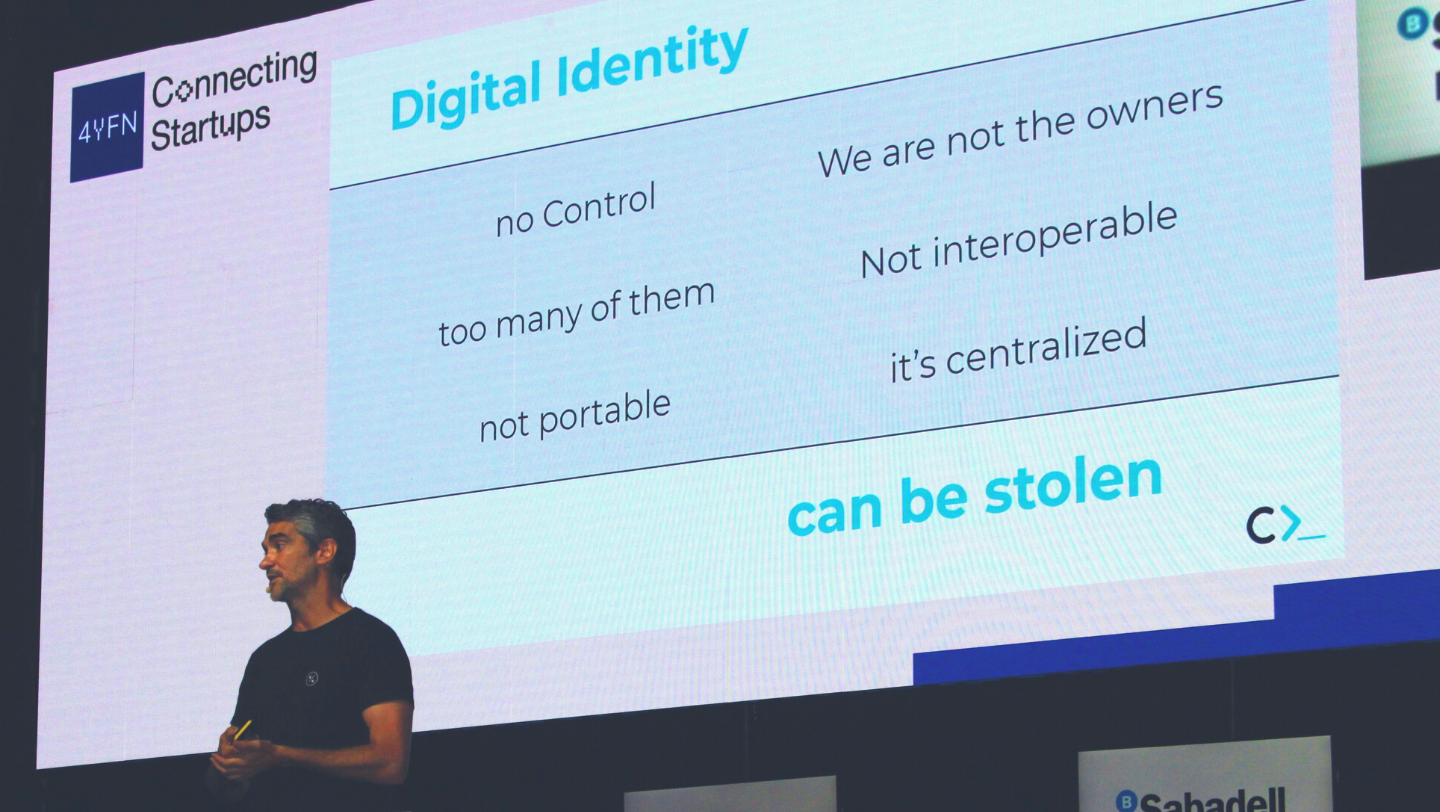
It was a powerful sentence to summarise the need of what Christopher Allen first defined in 2016: Self-Sovereign Identity (SSI). By the beginning of July, within the context of the 4YFN’s series of talks, the Next Generation Internet ambassador Àlex Puig presented some of his insights towards taking back control of our personal information online.
Fighting for privacy has been in the spotlight for decades. Now, in the age of big data, gaining full control over each citizen's digital identity is becoming an essential aspect of online democracy. This is, in fact, one of Next Generation Internet's main objectives, directly tackled through the eSSIF-Lab Research and Innovation Action of the NGI.
There has been a constant fear and uncertainty about how technology and technological development may affect humans, especially in a negative, foreboding and quasi-apocalyptic approach. However, the core question to be solved would rather be what us humans can do with technology, in particular to prevent our data from being used against us.
It is crucial for the human-centric generation of the Internet not only that the online identity is user-centric too, but also that it is completely controlled by the individual in all respects. In the words of Alex Puig, to take back control of our online information we need to decentralise information that has traditionally been centralised. And this involves using the so-called Self-Sovereign Identity.
Under the Self-Sovereign Identity rules, there can be individual, decentralised “boxes” that connect to different aspects of your online identity. Therefore, it avoids gathering all data under the same login details but, on the contrary, you only use that data of your online identity that is needed at each and every different moment. This means, for example, that your address information, which might be needed to deliver a purchased package to your place won’t be saved along or linked to your bank account details, nor even to your email address.
According to our ambassador, the Self-Sovereign Identity has a series of principles that must be followed to regain control over our digital selves. Those are:
In that regard, then, digital identity must switch from a common silos to a set of containers; where identity transforms into** identifiers that are no longer centralised and linked to one another. And over which the citizen can always be not only the controller, but the ruler**.
Those are steps that are being taken under the initiative hosted under the Next Generation Internet. Join the community to meet the projects, and the ambassadors who, like Alex Puig, are shaping the Internet of Humans.
#blockchain #digital-ethics #web #self-sovereign-identities-ssi